


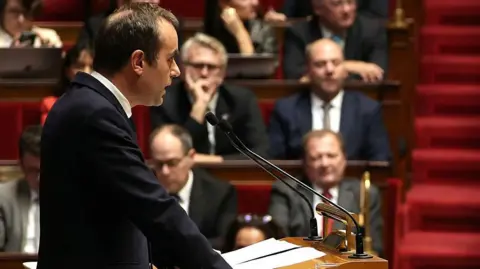
French Prime Minister Sébastien Lecornu has informed lawmakers that he backs freezing controversial retirement age changes implemented in 2023, preceding crucial votes of no-confidence in the coming days.
The reforms, which raised the retirement age from 62 to 64, were seen as defining measures in Emmanuel Macron's presidency.
"This autumn I will present to lawmakers that we freeze the retirement age changes until the 2027 election," the Prime Minister stated to support from progressive factions.
Lecornu was returned to office days ago only four days after he resigned, and needs the approval of Socialist MPs in the assembly if his cabinet is to survive.
Government Challenges
Opposition parties on the right-wing and far left have initiated censure votes on the cabinet, for midweek and are demanding new elections.
The Socialists stated they would be ready to back the cabinet, but only if it guarantees a complete halt of the president's retirement reforms.
"Should he fail to explicitly say the words 'full and instant suspension of the pension reform', it will be rejection," Socialist MP the socialist politician commented on national media.
"He is holding his destiny in his own hands. He understands what he has to do if he wants to avoid being the government leader who leaves office every week."
Previous Context
The measures were eventually passed by the assembly in March 2023, less than a year after the president was elected for a re-election.
There had been an extended period of national controversy, industrial action and public demonstrations, and in the end the proposal had to go through without a parliamentary approval in the assembly using a constitutional mechanism known as 49:3.
Last week, the Prime Minister said it was something many French people viewed as a "political scar" .
Economic Consequences
On this week he explicitly explained to representatives that halting the retirement changes would require millions in the coming years and a further €1.8bn in the presidential election year. This will have to be "balanced with other reductions," the Prime Minister stated.
Lecornu is France's third government leader in the recent period but even if he remains in office he needs to get a spending bill through parliament that lowers a spending gap estimated to reach over five percent of gross domestic product this year.
The country's national debt earlier this year amounted to trillions, or approximately 114 percent of economic output, the third biggest in the European monetary union after the Greek economy and the Italian nation.
Government Calculations
The Prime Minister has been one of the president's strongest supporters, so his move to row back on such a contested policy indicates how determined the head of state is to avert additional political crisis.
An economics expert, who was shared the Nobel Prize in Economics on recently, commented that he endorsed a suspension of the retirement changes, because it would still represent a reduced impact than the political uncertainty that would follow another government collapse.


